
Jefferson Release Dates Explained
A projected date is an estimate based on information known when the calculation is made. Mississippi Department of Corrections records use the more exact label Tentative Release Date. That wording matters. It is not an appointment at the gate, and it does not promise that the person will enter the community on that day. A later court order, a corrected credit, a loss of earned time, or a hold from another agency can change the outcome. The actual release date is the date a custodian records the person leaving that custody episode.
Jefferson/Franklin County Correctional Facility has a mixed role. It holds local detainees and MDOC prisoners. A local detainee awaiting trial has no sentence-based date to calculate. Bond, recognizance, dismissal, a time-served order, and the completion of release checks can control the exit. An MDOC prisoner at the same building follows state sentence computation. For that person, the public MDOC detail, the time sheet, and the eventual discharge or release document are the sound sources.
Find Jefferson Inmate Release Dates
Begin with the legal custodian, not just the building name. The MDOC inmate search accepts first name, last name, or MDOC ID. It serves people committed to state custody, including state prisoners housed at JCCF. It does not serve as a full archive of Jefferson County arrests. A person held locally before trial may never receive an MDOC number or state tentative date.
- Identify whether the case is a local booking, an MDOC sentence, or another jurisdiction's custody.
- For an MDOC prisoner, search by MDOC ID when known, open the individual result, and record its location, sentence blocks, and exact Tentative Release Date label.
- For a local jail sentence, ask JCCF for the existing time sheet or release calculation and ask the court clerk for the sentencing order and jail-credit term.
- Compare the displayed date with current custody. A date that has passed does not prove release.
- Escalate state time, jail-credit, or eligibility questions to MDOC Records rather than trying to recalculate the sentence from a summary screen.
The Jefferson County released-inmate search and records path helps when the custody system is uncertain. Keep the name, MDOC number or booking number, sentence county, and case number separate. Similar names are common. A match should rest on more than a name alone.
MDOC's official detail screen shows how the state labels the date field. The official field example is a structure example, not proof that the displayed person has been released.
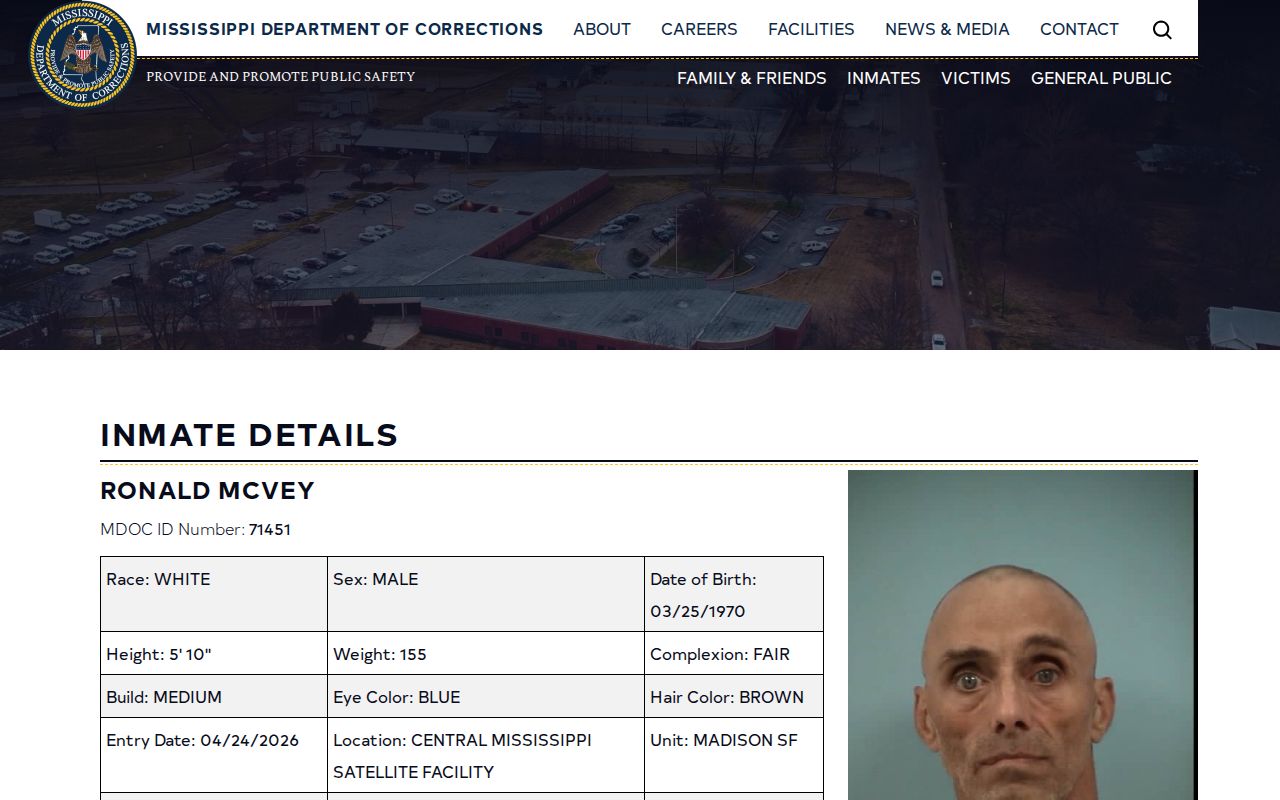
The screenshot places the tentative date beside MDOC identity, location, and sentence data. Those nearby fields prevent the estimate from being read without context.
Jefferson Release Record Fields
An MDOC detail record can include a photograph, MDOC ID, name, date of birth, physical descriptors, entry date, location, unit, a location-change date, total sentence length, and one or more sentence blocks. Each sentence block may name the offense, county of conviction, sentence date, and term. The public interface may change. Preserve the label and access date rather than silently renaming a field.
| Field | Why it matters |
|---|---|
| Tentative Release Date | The current MDOC estimate, not a guaranteed physical exit. |
| Location and unit | Shows the setting linked to the current state record. |
| Entry and sentence dates | Help identify the custody episode used in the calculation. |
| County of conviction | Points to the court that holds the controlling sentence order. |
| Total sentence length | Provides context, but does not reveal each credit or exclusion. |
| MDOC ID | Separates people with similar names and supports a Records request. |
No safe former-inmate example established that every discharged person remains online or that MDOC always shows a permanent Released or Discharged label. If a record is gone or unclear, ask MDOC Records for the existing discharge, release, or time-computation record. A missing result is not a release finding.
Note: Copy the field name as displayed because tentative release, parole eligibility, earned release, and maximum discharge are distinct dates.
Mississippi Release Date Computation
MDOC starts with the controlling sentence and its lawful commencement date. Eligible presentence jail credit may move the effective sentence start. The department then applies the rules that cover that person and offense. Concurrent sentences run at the same time, while consecutive sentences run one after another. Mandatory minimums, court amendments, program credit, earned-time rules, forfeiture, and restoration can all affect the calculation.
The MDOC Inmate Handbook says MDOC computes parole, earned-release supervision, tentative release or discharge, and maximum release dates. It also explains that qualifying county-jail credit is deducted when that confinement arose from the cause leading to the current incarceration and fits the applicable offense and sentence period. MDOC may seek information from the county of conviction. That is why a Jefferson County jail record and state time sheet sometimes must be reconciled.
- Jail credit
- Eligible time spent confined before the state sentence began.
- Concurrent
- Sentences that run at the same time.
- Consecutive
- Sentences served one after another.
- Detainer
- A notice that another authority may claim custody.
- Discharge
- The end of the identified sentence or supervision term.
Jefferson Earned Release Rules
Mississippi's earned-release framework is tied chiefly to Miss. Code Ann. §§47-5-138 and 47-5-139. The MDOC-hosted text of §47-5-138 states that, for covered sentences imposed after June 30, 1995, subsection (5) allows 4.5 days for each 30 days served when conduct and performance rules are met. It generally caps that allowance at 15 percent of the sentence.
This is the source of the common 85-percent shorthand. It is not a universal promise. Offense date, offense class, exclusions, age-related provisions, habitual status, mandatory terms, judicial conditions, and later changes in law can control eligibility. A simple subtraction from the sentence is therefore unsafe. MDOC must apply the governing rules to the actual record.
Earned Release Supervision, or ERS, also is not final discharge. It is conditional release based on earned credits and approved planning while the person remains in MDOC's jurisdiction. Parole follows a separate statute and Board process. Maximum discharge, ERS, parole eligibility, and tentative release should never be collapsed into one generic release date.
Why Jefferson Release Dates Change
A change is not always an error. Sentence information may arrive after the first computation. Credits can be earned, lost, restored, or corrected. A court can amend an order. Parole may be granted, denied, deferred, or rescinded, and even a grant can require an approved plan before physical release.
| Change | Effect on the date | Best source |
|---|---|---|
| Jail-credit correction | Moves the effective sentence start when MDOC accepts qualifying credit. | JCCF record, court order, and MDOC Records |
| Concurrent or consecutive amendment | Changes whether terms overlap or follow one another. | Sentencing court and MDOC Records |
| Earned-credit loss or restoration | Can move a tentative date later or earlier. | MDOC time computation |
| Parole action | Eligibility or a grant may create a path, but neither alone confirms exit. | Parole Board action and later MDOC status |
| Detainer or hold | May prevent community departure or send the person to another custodian. | Current custodian and receiving agency |
| New or amended court order | May alter the sentence, credit, or lawful basis for custody. | Court clerk and MDOC |
A date that passes with no community release calls for a new status check. It should not be treated as proof of a silent release or an improper detention. Ask which agency still holds the person and whether the date on the public screen has been recalculated.
Confirm Jefferson Inmate Release Dates
MDOC Records is the official escalation for offender time, jail credit, and eligibility dates. The MDOC contact directory lists P.O. Box 24388, Jackson, MS 39225, telephone 601-933-2889, and MDOCRecordsDepartment@mdoc.state.ms.us. Give the MDOC ID and ask for the existing time sheet, release or discharge record, jail-credit entries, and date-calculation record. Ask the Parole Board separately about a Board action.
Miss. Code Ann. §47-5-157 requires a dated and signed written discharge or release when MDOC discharges, paroles, pardons, or otherwise lawfully releases a prisoner. That document includes the person's name, conviction offense, sentence term and date, sentencing county, and other release information. As permitted by law, a copy from the person or MDOC is stronger proof of the state event than a tentative-date screenshot.
For a county sentence, call JCCF at 601-786-2284 and ask for the existing calculation or release record. Pair it with the court's sentencing order and jail-credit provision. For notification of an agency-fed event, the Jefferson County VINELink Release Check explains Mississippi SAVIN. The alert adds timely notice, but the custodian's record remains the proof.
The MDOC Family and Friends Guide distinguishes Tentative Release Date from Maximum Discharge. It describes the tentative date as the expected end of incarceration after earned-time and time-served adjustments, while maximum discharge reflects the expected date without early-release allowances. The guide also treats ERS and parole as separate paths. That vocabulary should carry into any Jefferson County record summary. A maximum date is not a parole date, and an eligibility date is not an exit.
State release planning can take time after the first expected date is known. MDOC's guide discusses a planning process that may take 30 to 45 days and says a case manager verifies a travel plan. That period describes state administrative planning, not extra sentence time or a guaranteed schedule. Its bus-ticket note also belongs only to MDOC releases and should not be applied to a local JCCF bond or time-served exit.
A pretrial detainee generally has no sentence-based MDOC release calculation. In that Jefferson County custody type, the meaningful date may depend on bond, dismissal, a local sentence, or another court order. Check the court and JCCF rather than forcing a state-prison date model onto a county booking.
If MDOC data and the court order appear to conflict, send the specific disputed item to the office that owns it. The sentencing court controls its order. JCCF can document the local confinement and release entries. MDOC Records calculates the state time and qualifying jail credit. Asking each office to correct another agency's field delays the answer and risks an inaccurate date.
Note: A transfer ends one agency's custody but does not show that the person entered the community.