
MDOC Jefferson County Coverage
MDOC covers people committed to the state prison and community-corrections system. Jefferson/Franklin County Correctional Facility can house MDOC state prisoners under a regional agreement, so an MDOC result may list a person connected with the Fayette facility. That does not make every person booked locally an MDOC offender. A pretrial detainee who was never committed to state custody may have no MDOC record at all.
For a state case, MDOC is the first online source. For a local booking, JCCF and the originating court remain primary. The systems can connect when a local detainee is sentenced and transferred to MDOC. Preserve both custody episodes rather than replacing the local exit with the later state record.
Search an MDOC Offender
The official search accepts first name, last name, or MDOC ID. The ID is the strongest starting point when known. A name search can return more than one person, so open the individual record and compare identifiers. Save the source URL, access time, and exact status wording because a live result can change.
- Open the MDOC inmate search.
- Enter the MDOC ID when known, or search by exact first and last name.
- Open the matching detail page rather than relying on a search-result summary.
- Compare the MDOC ID, physical descriptors, entry date, location, and sentence county.
- Read status, location, sentence blocks, and “Tentative Release Date” as separate fields.
- Contact MDOC Records when offender time, jail credit, or eligibility remains unclear.
A facility or regional location generally indicates confinement. A community-corrections or supervision indication may mean the person has left prison while remaining under MDOC control. A past date must be tied to the sentence and event shown. Later admissions, revocations, concurrent cases, and detainers can prevent one historical field from describing current status.
Note: A state record can verify the MDOC episode but cannot supply the missing release time for an unrelated county booking.
MDOC Release Search Fields
The observed official detail page provides a richer set of fields than a simple released-or-held result. It can show a photograph, MDOC ID, race, sex, date of birth, physical descriptors, entry date, location, unit, location-change date, number of sentences, and total sentence length. Sentence blocks can name the offense, term, county of conviction, and sentence date.
| MDOC field | How to read it |
|---|---|
| MDOC ID | Matches the state offender record |
| Location and unit | Shows the reported placement or supervision context |
| Entry and location-change dates | Describe state-system events, not necessarily local booking times |
| Sentence county and date | Connect the state term with the controlling judgment |
| Number and length of sentences | Warn against reading one date without the full sentence structure |
| Tentative Release Date | A current estimate subject to legal and administrative change |
The official detail-page field example shows the exact tentative-date label and record layout. It is a structure example, not evidence that the displayed person is a released Jefferson County inmate.
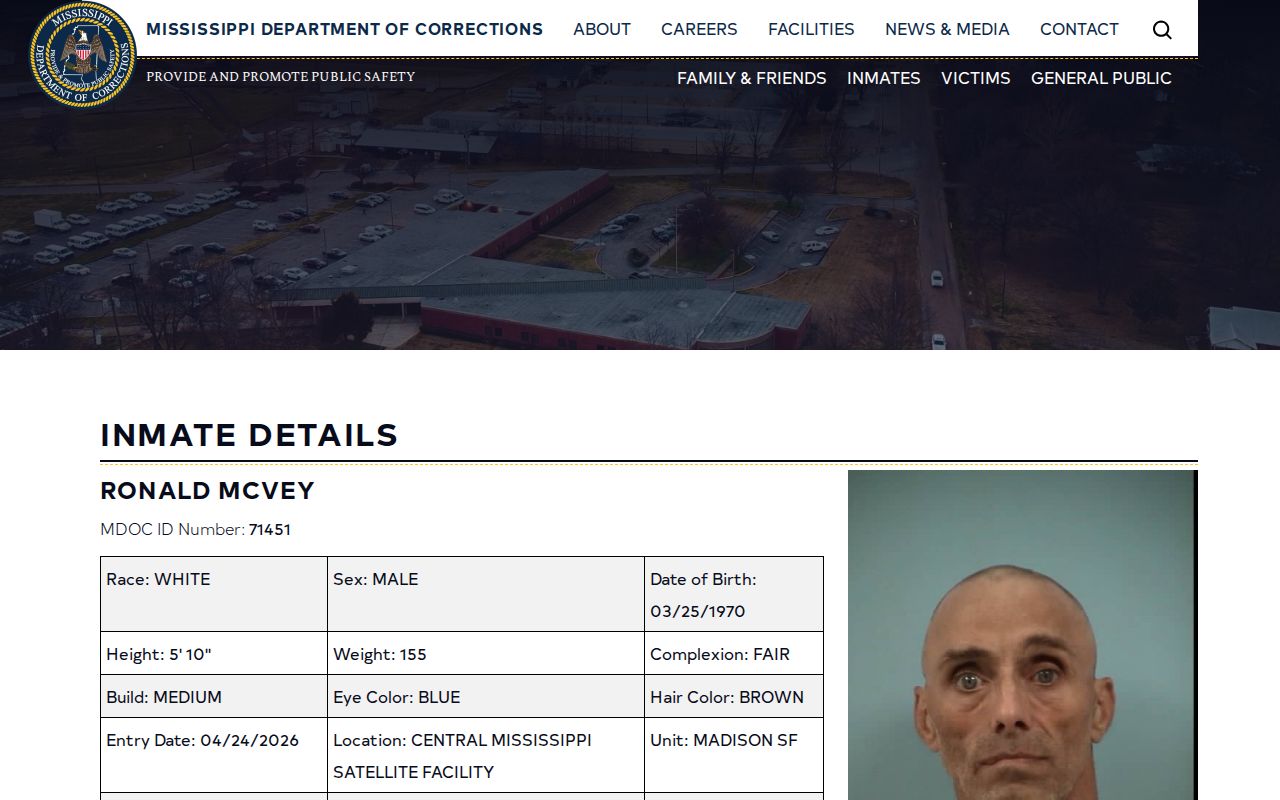
The image demonstrates why the field should not be renamed “actual release date” when the agency itself calls it tentative.
MDOC Records Contact
MDOC’s contact directory assigns offender time, jail credit, and eligibility-date questions to its Records Department. This is the authoritative escalation when the public search does not explain a computation. Identify the person by MDOC number and ask for the existing time sheet, jail-credit entries, release or discharge record, and date-calculation record that answers the specific issue.
MDOC Records Department
P.O. Box 24388
Jackson, MS 39225
Phone: 601-933-2889
Email: MDOCRecordsDepartment@mdoc.state.ms.us
Parole decisions go to the Mississippi State Parole Board, not MDOC Records. The Board publishes contact at 239 North Lamar Street, Suite 501, Jackson, MS 39202 and 601-576-3520. A Board action sheet can show grant, denial, or set-off. Even a grant does not prove physical release. Check the later MDOC or VINE status transition.
MDOC Tentative Date Changes
A tentative release date begins with the controlling sentence and commencement date, then incorporates eligible presentence jail credit and applicable credit rules. Consecutive or concurrent terms, mandatory minimums, court amendments, earned credits, forfeiture, restoration, program credit, and legal classification can alter the result. A detainer may also prevent community departure even when one sentence reaches an expected point.
Mississippi’s earned-release framework includes Miss. Code Ann. §§47-5-138 and 47-5-139. The often repeated 85-percent shorthand comes from a covered earned-allowance regime that generally limits an allowance to 15 percent. It is not a promise for every prisoner. Offense date, offense type, exclusions, habitual status, mandatory terms, and sentence structure matter. Parole eligibility under §47-7-3 is a separate calculation.
Earned Release Supervision is conditional release based on credits and an approved plan. The MDOC handbook states that the person retains inmate status and remains within MDOC jurisdiction. Parole is also conditional but uses a separate Board process. Maximum discharge ends the listed term. Those labels should never be collapsed into one generic release date.
Note: A tentative date that passes without a recorded transition calls for a fresh MDOC status check, not an assumption.
JCCF and MDOC Records
JCCF’s regional role creates a specific Jefferson County handoff. The sheriff manages daily operations under an MDOC agreement, while MDOC oversees state-inmate housing and owns the state sentence computation. Ask JCCF for a locally created booking timestamp or physical exit disposition. Ask MDOC Records for state offender time, jail credit, and eligibility. Ask the Circuit Clerk for the controlling judgment or amendment.
A JCCF record may say “released to MDOC.” That means the local episode ended through transfer. The later MDOC record then establishes the state placement. Conversely, a person can leave JCCF for another MDOC facility without leaving state custody. Read the receiving agency and location-change field before describing what occurred.
The JCCF release page gives the facility-side proof path. Using both records when needed creates a custody chain without treating one agency’s event as a universal status.
MDOC Supervision and Discharge
The public parolee search accepts a name or MDOC ID and also exposes city and county fields. It can confirm someone released from state prison onto parole. It is not a probationer database and does not cover a person who merely bonded out of JCCF. No verified public MDOC probationer or absconder list was found, so those questions go to Community Corrections.
The MDOC directory lists a “Jefferson Probation & Parole Office” in Hazlehurst, outside Jefferson County, and labels its county as Copiah. Readers should call before traveling or assuming assignment. Residence alone does not prove which office supervises a person. A discharge certificate, when available, is stronger proof that the listed MDOC sentence or supervision term ended than a bare screen label.
- Tentative release
- An estimate that can change before the actual state event.
- Parole
- Conditional release decided by the Board and supervised in the community.
- Earned Release Supervision
- Conditional release based on eligible credits while MDOC jurisdiction continues.
- Discharge
- Completion of the specified sentence or supervision term.
Mississippi SAVIN/VINELink may send release, transfer, return, escape, or supervision events for participating providers. It is a notification layer. Keep the agency name and event wording, then confirm the official MDOC record. The statewide search also does not cover BOP or ICE custody.
MDOC Sentence Computation Proof
The MDOC Inmate Handbook says the department computes parole, Earned Release Supervision, tentative release or discharge, and maximum release dates. Eligible presentence county-jail credit can affect the sentence start when the confinement arose from the cause leading to the current incarceration and fits the applicable offense and sentence period. MDOC may request the supporting data from the county of conviction. That is why JCCF's local confinement record and the state time sheet sometimes must be reconciled.
Miss. Code Ann. §47-5-138 supplies the basis for the often misstated 85-percent shorthand. In a covered regime, the earned allowance is generally capped at 15 percent and depends on conduct and performance. It is not an automatic reduction for every prisoner. Offense date, exclusions, mandatory terms, habitual status, sentence structure, forfeiture, restoration, and court changes can alter the calculation. A public Tentative Release Date should never be reverse-engineered into a case-specific promise.
Section 47-5-157 provides a stronger release artifact. It calls for a dated and signed written discharge or release when MDOC lawfully discharges, paroles, pardons, or otherwise releases a prisoner. The document includes sentence and conviction information along with the state event. As allowed by law, obtain that record from the person or MDOC and compare it with the public result. A certificate records the event; a tentative date forecasts it.